
Teknik Rehber
What Is a Mass Flow Sensor? How Is It Used in Medical and Industrial Gas Measurement?
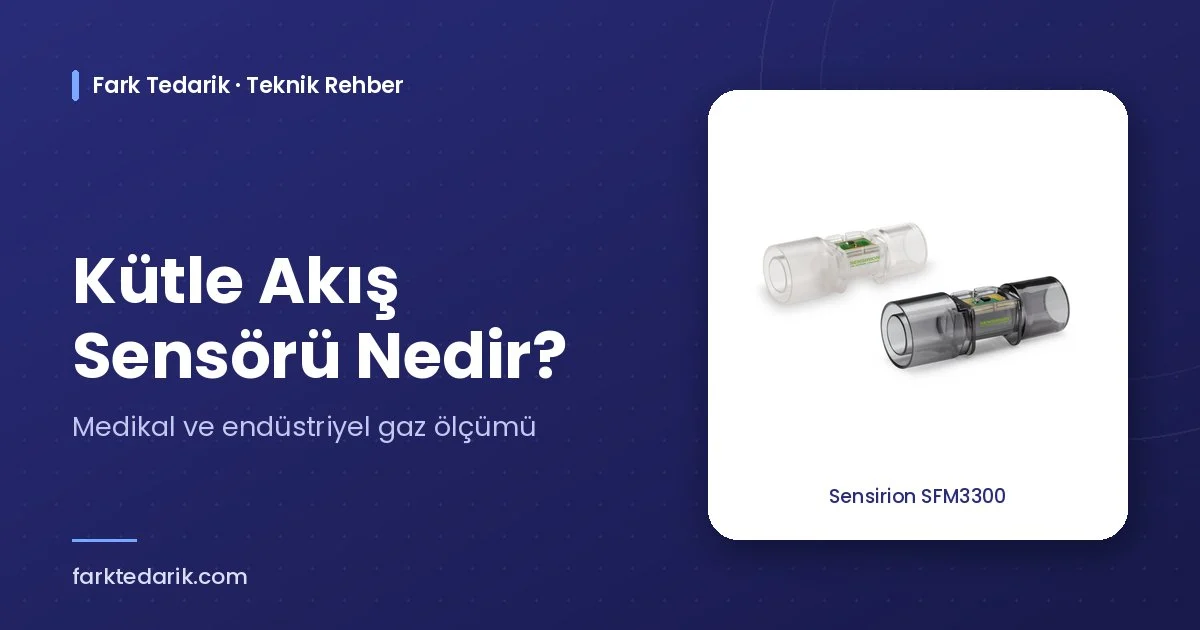
A mass flow sensor is a device that measures the amount of gas passing through a line per unit of time and usually gives the result in slm (standard litres per minute) or sccm (standard cubic centimetres per minute). Unlike volumetric measurement, mass flow reflects the actual amount of gas even when the temperature and pressure of the gas change. That is why it is widely used in mechanical ventilators, anaesthesia devices, gas blending systems and laboratory equipment. In this article we summarise the basics and how to choose the right sensor for those looking into “how does a flow sensor work” or “how is flow measured in a ventilator”.
How Mass Flow Sensors Work
Sensirion’s mass flow sensors are based on the thermal (calorimetric) measuring principle. On the CMOSens® chip there is a small heater with temperature sensors on both sides. When no gas flows, the heat is distributed symmetrically, when flow starts the heat is carried in the direction of flow and a difference arises between the two temperature sensors. This difference is directly related to the mass flow of the gas. Since the same structure also detects the direction of flow, the sensors can measure bidirectionally (inhalation and exhalation).
Signal processing, calibration and temperature compensation are done on the same chip, and the result is transferred digitally (I²C on most models) to the microcontroller. Since there are no moving parts, a thermal mass flow sensor has no wear compared with mechanical flow meters, and its response time is in the millisecond range.
Where Is It Used?
Mass flow sensors are used in every application where the amount of gas must be controlled precisely:
- Mechanical Ventilators: The amount of air delivered to and returning from the patient is measured continuously, tidal volume and the breathing cycle are controlled with this data.
- Anaesthesia Devices: Fresh gas flow and the flow in the breathing circuit are monitored in real time for anaesthesia safety.
- Neonatal and Paediatric Respiration: These applications, where very small volumes are measured, require fast sensors with low dead volume.
- Gas Blending: Mixing gases such as oxygen and air in specific ratios is achieved by measuring the flow of each line.
- Laboratory and Analytical Instruments: Carrier gas flow is controlled in gas chromatography, spectroscopy and test setups.
- Process Automation: In industrial processes, the consumption of air and non-corrosive gases is measured and recorded.
Why Is a Mass Flow Sensor Needed?
Estimating gas flow only from pressure or valve position gives wrong results under changing temperature and pressure conditions. In medical devices this error directly affects patient safety, in industry it leads to gas waste and quality problems. A mass flow sensor that measures directly provides a reliable data source for closed-loop control, alarm generation and consumption logging. Questions such as “why is the ventilator flow sensor important” or “how is gas consumption measured” also arise from this need.
The Solution: Sensirion SFM Series Mass Flow Sensors
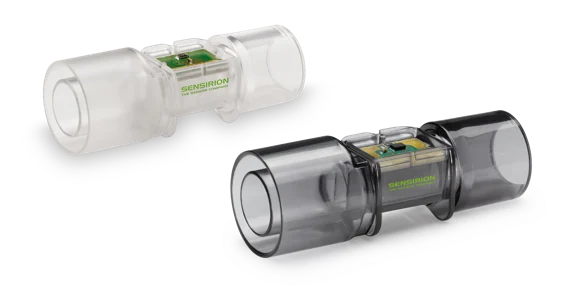
The Sensirion SFM series offers separate models for different flow ranges and use cases. The SFM3300 is designed for proximal flow measurement in ventilation and anaesthesia applications with a bidirectional measuring range of ±250 slm, it is calibrated for air and O₂ and is available in autoclavable (AW) and disposable (D) versions. The SFM3200, with a range of -100 … +250 slm, stands out in inspiratory flow measurement especially for its low pressure drop and its accuracy at low flows.
For neonatal and paediatric applications the SFM3400 stands out with its ±33 slm range and a dead volume below 1 ml. In gas blending systems that require measurement on the high-pressure side, the SFM4200 measures in the 0–160 slm range at operating pressures up to 8 bar. All of these models offer a 0.5 ms update time and a digital I²C interface.
You can source these sensors in Türkiye through Fark Tedarik:
You can browse all models in our Flow Sensors category. You can request a quote for price and lead time based on project quantities.
Additional Advantages and Usage Tips
If you maintain an existing device, older generation models such as the ASF1430 also matter. The ASF1430 is a mass flow meter that measures bidirectionally in the ±400 sccm range and can be connected directly to a computer with its RS-232 interface, it is supplied for the maintenance and spare part needs of systems that use the ASF1430.
When choosing a mass flow sensor, consider the flow range, the medium gas, the operating pressure and the acceptable pressure drop together. For a lower-cost flow measurement, differential pressure sensors used together with an orifice are also an alternative. To choose the right model for your application, contact the Fark Tedarik team: https://farktedarik.com/iletisim/.
Frequently Asked Questions
What is the difference between mass flow and volumetric flow?
Volumetric flow measures the volume the gas occupies and changes with temperature and pressure. Mass flow measures the actual amount of gas, since Sensirion sensors give the result relative to standard conditions (slm/sccm), the measurement is not affected by ambient conditions.
What do slm and sccm mean?
slm means “standard litres per minute” and sccm means “standard cubic centimetres per minute”. 1 slm equals 1,000 sccm. The word “standard” indicates that the flow is calculated relative to a reference temperature and pressure.
What is the difference between the SFM3300 and the SFM3200?
Both are for respiratory and anaesthesia applications. The SFM3300 measures symmetrically bidirectionally at ±250 slm and has a disposable version, the SFM3200 is optimised for the -100 … +250 slm range, low pressure drop and inspiratory flow measurement.
Can these sensors be used with oxygen?
The SFM3200, SFM3300, SFM3400 and SFM4200 are designed for use with air and O₂. If you plan to use a different gas, we recommend that you contact us to check suitability.