
Teknik Rehber
What Is a Differential Pressure Sensor? How Is It Used in HVAC and Medical Applications?
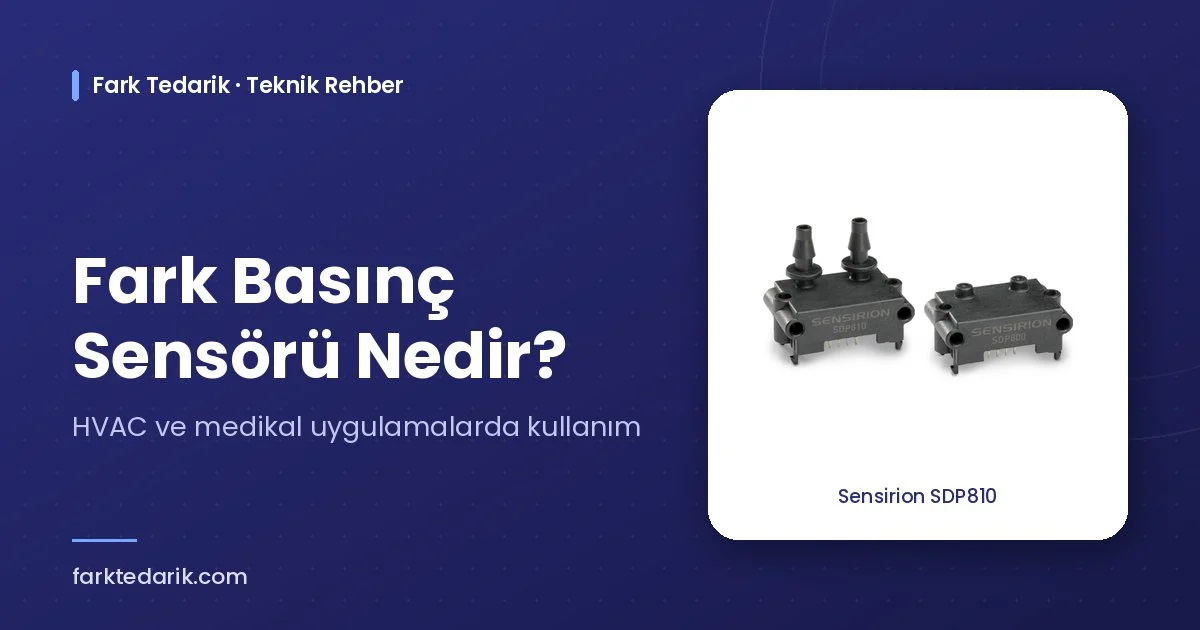
A differential pressure sensor is a device that measures the pressure difference between two measuring points in Pascal (Pa). Since it detects not the absolute pressure but the difference between two ports, it is used to monitor air flow in ventilation ducts, how clogged filters are, or the pressure of a room relative to neighbouring areas. For engineers looking for answers to “how does a differential pressure sensor work” or “how is filter clogging measured”, these sensors are a basic part of many designs, from HVAC systems to respiratory devices. Precise and stable measurement, especially in low pressure ranges (a few hundred Pa), is decisive for energy efficiency and safety.
How Differential Pressure Sensors Work
Most differential pressure sensors on the market work on the membrane (diaphragm) principle: the deflection of a flexible membrane separating two pressure chambers is measured. Although this structure gives good results at high pressures, sensitivity decreases at very low pressures and the zero point can drift as the membrane fatigues over time, so periodic calibration may be needed.
Sensirion’s SDP series uses the thermal flow-through principle. The pressure difference between the two ports passes a very small gas flow through the sensor. The micro heater and two temperature sensors on the CMOSens® chip measure this flow, and the result is converted into a factory-calibrated, temperature-compensated pressure value. Since there are no moving parts there is no zero point drift, and the highest sensitivity is achieved exactly in the low pressure range that HVAC applications need. Depending on the model, the output can be digital (I²C) or analog (0.25–4.0 V).
Where Is It Used?
Differential pressure sensors are found in almost every system where air or gas flow is controlled:
- VAV and Ventilation Systems: In variable air volume (VAV) boxes the air flow is calculated from the pressure difference in the duct and the dampers are adjusted accordingly.
- Filter Clogging Monitoring: As the pressure drop across the filter increases, the filter is getting clogged. The sensor makes it possible to replace the filter according to actual need rather than “by the calendar”.
- Clean Rooms and Hospital Rooms: In operating theatres, isolation rooms or clean rooms, positive or negative pressure must be maintained relative to neighbouring areas, the differential pressure sensor monitors this balance continuously.
- Fan and Burner Control: Pressure difference measurement is used to verify fan performance and combustion air.
- Medical Devices: In CPAP and sleep apnoea devices and respiratory equipment, low-range sensors with fast response are preferred for flow and pressure control.
- Heat Recovery Units: The pressure difference across the heat exchanger and fan lines shows whether the unit is working efficiently.
Why Is a Differential Pressure Sensor Needed?
In ventilation and air conditioning systems the air flow cannot be seen directly, but it can be calculated reliably from the pressure difference. In a system where the pressure difference is not measured, fans run more than necessary, dirty filters go unnoticed and the pressure balance in areas that require hygiene can be disturbed. A correctly chosen differential pressure sensor makes it possible to adjust energy consumption to demand, carry out maintenance on time and record the pressure conditions required by regulations. Questions such as “what should the filter pressure difference be in Pa” or “how does a VAV system work” actually show how important correct measurement is.
The Solution: Sensirion SDP810 and SDP1000/SDP2000 Differential Pressure Sensors
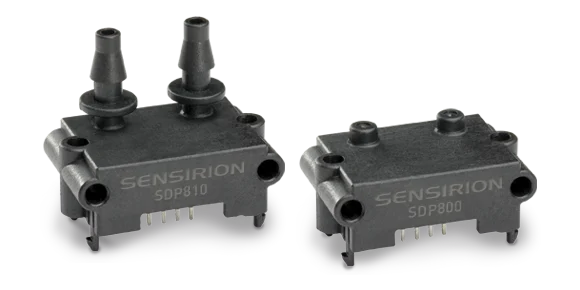
For designs that require a digital output, the Sensirion SDP810-500Pa offers a ±500 Pa measuring range, an accuracy of 3% of reading and a zero point accuracy of 0.1 Pa. Thanks to its I²C interface and 2.7–5.5 V supply range it connects directly to microcontrollers, and its tube-connection housing makes mounting easier in duct and filter applications. It is calibrated for air and N₂.
On control boards that use analog signals, the SDP1000/SDP2000 series stands out. The SDP2000-L gives a linear 0.25–4.0 V output in the 0–3,500 Pa range, while the SDP2000-R and the SDP1000-R with a 0–500 Pa range offer a square-root extracted output. The square-root characteristic reduces extra calculation because it gives a signal proportional to flow in flow measurements with an orifice or venturi. These models have no offset or hysteresis and are insensitive to mounting orientation.
You can source these sensors in Türkiye through Fark Tedarik:
You can compare all models in our Differential Pressure Sensors category and choose the range and output type that fits your needs.
Additional Advantages and Usage Tips
If you want to try the sensor under real conditions before starting a new project, the Evaluation Kit EK-P5 makes it easier: the kit consists of the SDP810-500Pa sensor and a USB adapter, you can monitor measurements on a computer and export them to Excel without programming a microcontroller. When mounting, because of the thermal flow principle it is recommended to keep the tubes to the sensor as short as possible and of equal length, long and thin tubes can affect the measurement.
By combining differential pressure measurement with data from a particulate sensor and a CO2 sensor you can monitor both the filter condition and indoor air quality in one system. To choose the right model for your project together, contact the Fark Tedarik team: https://farktedarik.com/iletisim/.
Frequently Asked Questions
What is the difference between a differential pressure sensor and a pressure sensor?
A standard pressure sensor measures the pressure at one point (absolute or relative to atmosphere). A differential pressure sensor measures the pressure difference between two ports, so values such as air flow, filter pressure drop and room pressure can be calculated.
Should I choose a differential pressure sensor with digital or analog output?
In new microcontroller-based designs, digital sensors with I²C output such as the SDP810 make integration easy. On existing control boards with analog inputs or in PLC systems, the SDP1000/SDP2000 series with 0.25–4.0 V output is more practical.
What is a square-root output sensor used for?
With restrictors such as an orifice or venturi, the flow is proportional to the square root of the pressure difference. The square-root output SDP1000-R and SDP2000-R give a signal directly proportional to flow and simplify the flow calculation.
Do Sensirion SDP sensors require calibration?
SDP sensors are factory calibrated and show no zero point drift thanks to the thermal flow principle, so periodic zero calibration as with membrane sensors is usually not needed.