
Teknik Rehber
SHT3x vs SHT4x: Which Sensirion Humidity Sensor Should You Choose?
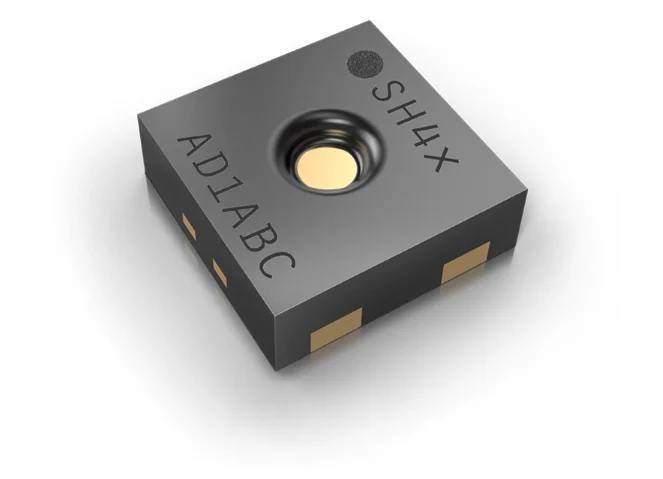
SHT3x and SHT4x are Sensirion’s digital humidity and temperature sensor families. Both communicate via I²C and come factory calibrated. In this article we put the key values from the manufacturer documents of the two families side by side, to help you see which one is suitable when designing a new board or updating an existing design. All values are taken from Sensirion’s datasheets and the SHT3x to SHT4x transition guide, the sources are listed at the end of the article. For the general working principle of humidity and temperature sensors see our article What Is a Humidity and Temperature Sensor?
What is the difference in short?
SHT4x has a smaller package, works at a lower voltage and has a lower average current. SHT3x accepts a supply of up to 5.5 V, its 8-pin package has an ALERT output and it offers two selectable I²C addresses. Which one to choose is usually decided by the supply voltage, the space on the board and the expected battery life.
Key values
| Feature | SHT3x (SHT30, SHT31, SHT35) | SHT4x (SHT40, SHT41, SHT43, SHT45) |
|---|---|---|
| Package | DFN, 8 pins, 2.5 × 2.5 × 0.9 mm | DFN, 4 pins, 1.5 × 1.5 × 0.5 mm |
| Supply voltage | 2.15 – 5.5 V | 1.08 – 3.6 V (up to 5.5 V for the SHT4xI version) |
| Typical humidity accuracy | ±2% RH for SHT30 and SHT31, ±1.5% RH for SHT35 | ±1.8% RH for SHT40, SHT41 and SHT43, ±1.0% RH for SHT45 |
| Typical temperature accuracy | ±0.2 °C for SHT30 and SHT31, ±0.1 °C for SHT35 | ±0.2 °C for SHT40, SHT41 and SHT43, ±0.1 °C for SHT45 |
| Average current (1 measurement per second) | 1.7 µA | 0.4 µA |
| Humidity response time (τ63%) | 8 s | 4 s |
| Long-term humidity drift (typical) | below 0.25% RH/year | below 0.2% RH/year |
| Heater | For plausibility checks only | Powerful heater, fully functional in condensing environments |
| I²C | Up to 1 MHz, two selectable addresses | Fixed address depending on the version: 0x44, 0x45 or 0x46 |
When to choose SHT4x?
- If the board is supplied with 3.3 V or less and space is limited. The 1.5 × 1.5 mm package is clearly smaller than the 2.5 × 2.5 mm package of SHT3x.
- If the device runs on batteries. According to the transition guide, the average current at one measurement per second is 1.7 µA for SHT3x and 0.4 µA for SHT4x.
- If condensation may occur in the environment. Sensirion states that SHT4x is fully functional in condensing environments and has a powerful heater.
- If a faster humidity response is required. The humidity response time is given as 8 s for SHT3x and 4 s for SHT4x.
When to choose SHT3x?
- If the supply line is 5 V. SHT3x works in the 2.15 – 5.5 V range.
- If an output is needed that wakes up the microcontroller or drives a transistor when a threshold is exceeded. The ALERT pin of SHT3x changes state according to programmable humidity and temperature limits.
- If an existing SHT3x design works and no board change is wanted. Moving to SHT4x requires redrawing the board because the package and pinout change.
Points to watch when migrating
When moving from SHT3x to SHT4x, the package goes from 8 pins to 4 pins, the upper supply limit drops from 5.5 V to 3.6 V and the command set is different. Therefore both the board layout and the software driver must be updated. For details see Sensirion’s SHT3x – SHT4x transition guide.
Models at Fark Tedarik
- SHT30-DIS-B Humidity and Temperature Sensor
- SHT31-DIS-B Humidity and Temperature Sensor
- SHT35-DIS-F Humidity and Temperature Sensor with Filter
- SHT35-DIS-B Humidity and Temperature Sensor
- SHT3x Series
- SHT40-AD1B-R2 Humidity and Temperature Sensor
- SHT31 Smart Gadget Development Kit
For all models see the SHT3x series and SHT4x series categories. For bulk purchases or project-based needs you can contact us.
Sources
- Sensirion, Datasheet SHT3x-DIS
- Sensirion, Datasheet SHT4x
- Sensirion, SHT3x – SHT4x Transition Guide
- Sensirion, SHT3x Alert Mode application note