
Teknik Rehber
What Is a Digital Temperature Sensor? Which Sensor to Choose for Precise Temperature Measurement?
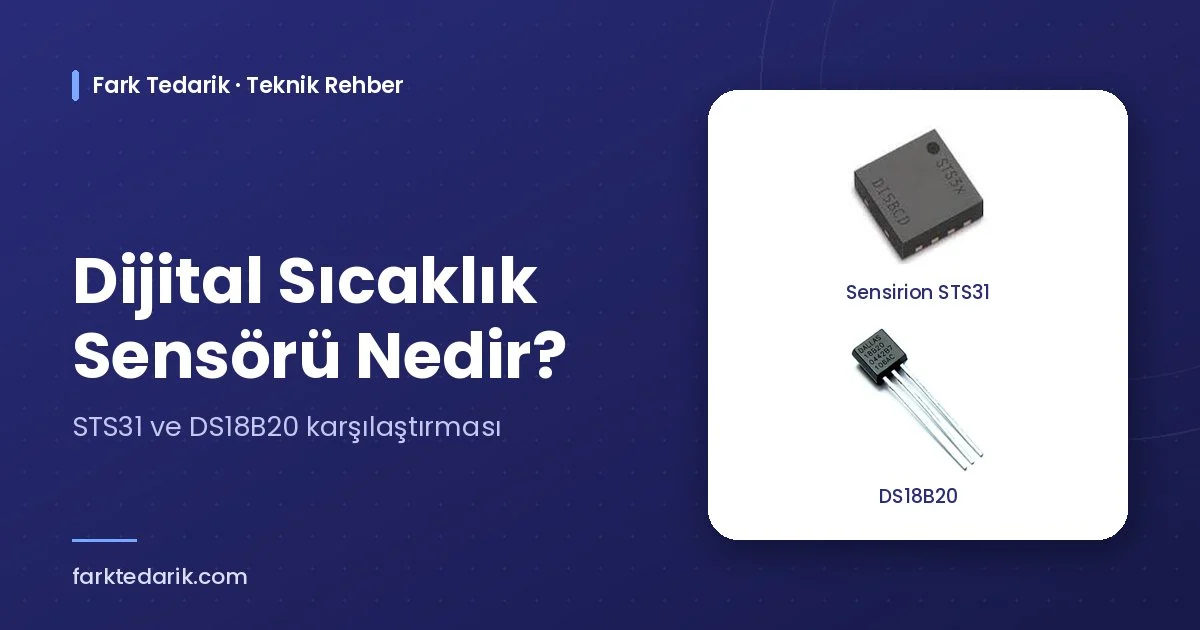
A digital temperature sensor is a temperature sensor that measures the temperature of the environment or a surface and delivers the result directly as digital data. With analog elements such as NTC thermistors or PT100s, the measured resistance or voltage must also be amplified, converted and calibrated, in digital sensors all of this is done inside the sensor. In this article we explain how digital temperature sensors work and compare two popular models for those looking into “which temperature sensor is more accurate” or “how to measure temperature with Arduino”. If you also need to measure humidity along with temperature, take a look at our humidity and temperature sensors article.
How Digital Temperature Sensors Work
Most digital temperature sensors use a semiconductor band-gap reference: the voltage of silicon junctions changes predictably with temperature. The sensor digitises this voltage with its internal A/D converter, corrects it with the factory calibration data and sends the result to the microcontroller over an interface such as I²C, 1-Wire® or SPI.
The biggest advantage of this approach is that cable resistance, noise and reference voltage errors do not get into the measurement. Since each sensor is factory calibrated, no recalibration is needed when it is replaced, and several sensors can be used on the same line.
Where Is It Used?
Digital temperature sensors are preferred in many areas that require precise and repeatable measurement:
- Medical and Laboratory Devices: Tight-tolerance temperature control in incubators, analysers and sample storage units.
- HVAC and Smart Thermostats: Room, duct and water line temperatures are monitored and heating and cooling are adjusted as needed.
- Cold Chain and Storage: In food and pharmaceutical storage the temperature is logged continuously and an alarm is generated when a limit is exceeded.
- Industrial Machines: Overheating in motors, cabinets, liquid tanks and process lines is detected early.
- White Goods and IoT Devices: Low-power digital sensors are used in refrigerators, ovens and wireless sensor nodes.
Why Is a Digital Temperature Sensor Needed?
Getting accurate measurements with analog sensors requires precision resistors, a reference voltage, an amplifier and a calibration process, each of which is an extra cost and a source of error. Digital sensors deliver the calibrated, linearised result directly. This shortens design time, removes the calibration step in production and makes replacing sensors in the field easier. This reliability is especially important in cold chain and medical applications, where measurement records are used as evidence in audits.
The Solution: Sensirion STS31 and DS18B20 Digital Temperature Sensors
For designs that require high accuracy, the Sensirion STS31-DIS offers a typical accuracy of ±0.2 °C in the 0–90 °C range. With its -40 … +125 °C operating range, 2.15–5.5 V supply and factory-calibrated I²C output it connects directly to microcontrollers, and two selectable I²C addresses allow two sensors on the same line. Its 2.5 × 2.5 × 0.9 mm DFN package is ideal for small and precise devices.
If you need to measure at remote points over a cable or connect many sensors on a single line, the DS18B20 is a practical choice. It communicates over a single data line with the 1-Wire® interface, and thanks to the unique 64-bit serial code of each sensor many DS18B20s can work on the same line. It has a measurement range of -55 … +125 °C, an accuracy of ±0.5 °C in the -10 … +85 °C range and a selectable resolution of 9–12 bits. Its TO-92 package is suitable for through-hole mounting.
You can order these sensors from Fark Tedarik with a company invoice:
For models that measure humidity and temperature together you can browse our Humidity and Temperature Sensors category.
Additional Advantages and Usage Tips
To decide which sensor to choose, it is enough to answer three questions: How much accuracy is needed, will the sensor be mounted on the board or carried away on a cable, and how many points will be measured? If ±0.2 °C accuracy is needed on the board, the STS31 stands out, if measurement at several points with a cable and a simple line is needed, the DS18B20 stands out. For sensors on the board, placing them away from heat sources such as regulators or processors noticeably improves measurement accuracy.
Both sensors can easily be used with ready-made libraries on platforms such as Arduino, ESP32, STM32 and PIC. To choose the right temperature sensor for your project, contact the Fark Tedarik team: https://farktedarik.com/iletisim/.
Frequently Asked Questions
What is the difference between a digital temperature sensor and an NTC?
An NTC is an analog element whose resistance changes with temperature, measuring requires additional circuitry, A/D conversion and calibration. A digital temperature sensor does these steps internally and delivers the calibrated result directly in digital form.
How long a cable can the DS18B20 be used with?
The cable length depends on the cable type, the line topology, the pull-up resistor and the number of sensors on the line. For long lines, twisted pair cable and a suitable pull-up resistor are recommended.
Which is more accurate, the STS31 or the DS18B20?
The STS31 offers a typical accuracy of ±0.2 °C in the 0–90 °C range, the DS18B20 has an accuracy of ±0.5 °C in the -10 … +85 °C range. The STS31 stands out for higher accuracy, the DS18B20 for multi-point and cabled measurement.
What should I use if I also need to measure humidity along with temperature?
In that case Sensirion sensors that measure humidity and temperature on a single chip, such as the SHT3x or SHT4x series, are more suitable.