
Teknik Rehber
What Is a Class D Amplifier? Efficient Audio Amplifier Design with the TDA8932BT

A Class D amplifier is a highly efficient type of audio amplifier that drives the loudspeaker by converting the audio signal into a high-frequency pulse width modulated (PWM) signal. It is used in most of today’s audio devices, from flat-screen televisions to active speakers. In this article we explain the working principle and a common IC, the NXP TDA8932BT, for users and repair technicians searching for “what is a Class D amplifier”, “does a Class D amplifier get hot” or “TV audio IC”.
How Class D Amplifiers Work
In classic class A, B and AB amplifiers the output transistors work in the linear region and the difference between the signal and the supply is dissipated as heat. In a Class D amplifier, however, the output transistors (usually MOSFETs) are switched only fully on or fully off. The audio signal is compared with a carrier of several hundred kHz and converted into a PWM signal whose pulse width varies with the audio signal.
This PWM signal is amplified in the output stage, then passed through an LC low-pass filter that removes the high-frequency components, so only the audio signal reaches the loudspeaker. Because very little power is lost in the switching transistors, the efficiency is clearly higher than in class AB. The output can be used in single-ended (SE) or bridge-tied load (BTL) configuration.
Where Is It Used?
Class D amplifiers are preferred in every audio application where efficiency and compact design matter:
- Flat-Screen TVs and Monitors: Thin housings have no room for a large heatsink, so high-efficiency audio ICs are used.
- Active and Wireless Speakers: In Bluetooth and Wi-Fi speakers they provide low heat, small size and long battery life.
- Multimedia Systems and Docking Stations: Used in computer speakers and desktop audio systems.
- Micro Music Systems: Serve as the stereo output stage in compact music systems.
- Audio Board Repair: The IC is replaced on faulty TV and speaker audio boards.
Why Is a Class D Amplifier Needed?
In a class AB amplifier the losses increase as the output power increases, which means large heatsinks, stronger power supplies and larger housings. A Class D amplifier produces the same output power with much less heat. As a result devices become thinner, lighter and more energy efficient, and battery-powered devices run longer. With a properly designed filter and layout the sound quality is also very good for everyday use.
The Solution: NXP TDA8932BT Class D Audio Amplifier
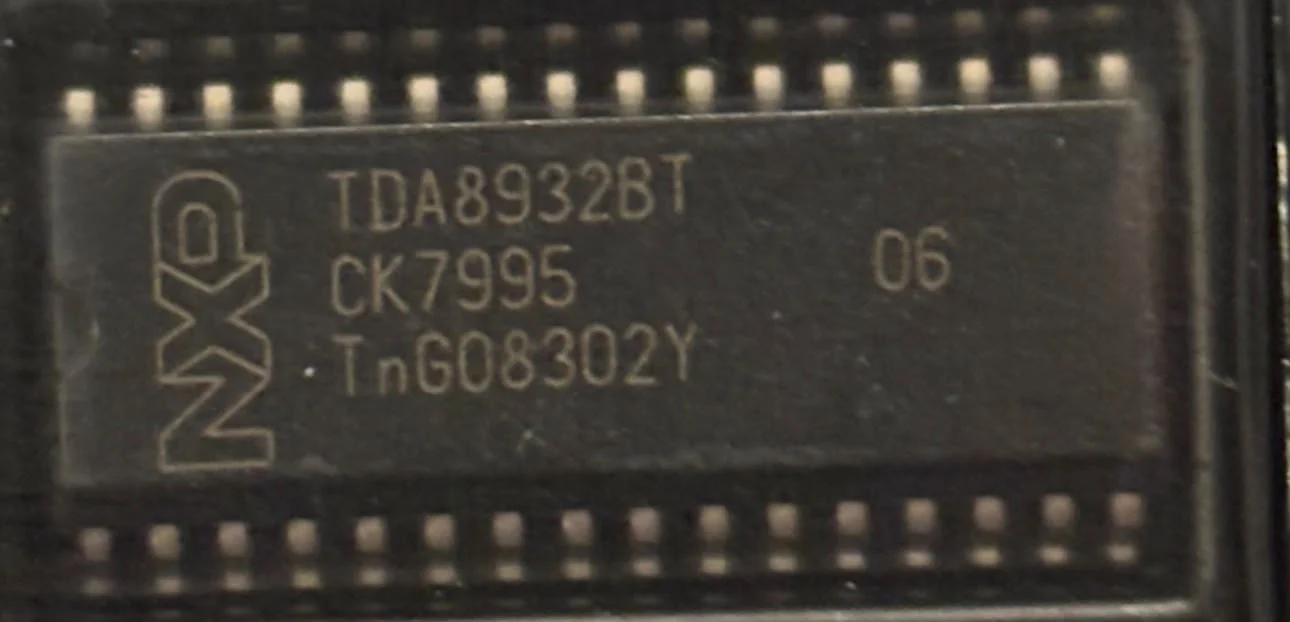
The TDA8932BT is a high-efficiency, low power dissipation Class D audio power amplifier from NXP Semiconductors. It delivers 2 × 15 W (4 Ω) continuous output power in stereo half-bridge (SE) configuration and 1 × 30 W (8 Ω) in mono full-bridge (BTL) configuration. It works with a 10–36 V asymmetrical or ±5 … ±18 V symmetrical supply. It has thermal protection and thermal foldback, full short-circuit protection and current limiting, and its fully differential inputs provide noise immunity. It comes in a 32-pin SO32 SMD package.
You can order this IC from Fark Tedarik with a company invoice:
You can browse other ICs in our Integrated Circuits category.
Additional Advantages and Usage Tips
When designing or repairing with the TDA8932BT, the inductor and capacitor values in the output LC filter must suit the loudspeaker impedance, the reference values in NXP’s application note are a good starting point. Low-ESR decoupling capacitors close to the supply line and large ground areas reduce both noise and heating. To spread the heat, enough copper area connected to the ground pins of the IC should be left on the board.
If there is still no sound after replacing the IC during a repair, check the supply voltage, the output filter components and any short circuits that may put the IC into protection mode. For bulk purchases and project-based needs contact Fark Tedarik: https://farktedarik.com/iletisim/.
Frequently Asked Questions
What is the difference between a Class D amplifier and a class AB amplifier?
In a class AB amplifier the output transistors work linearly and a large part of the energy turns into heat. In a Class D amplifier the transistors work in switching mode, so the efficiency is much higher and heating and the need for a heatsink are much lower.
How many watts does the TDA8932BT deliver?
It delivers 2 × 15 W (4 Ω) continuous output power in stereo SE configuration and 1 × 30 W (8 Ω) in mono BTL configuration.
What supply voltage does the TDA8932BT work with?
It can work with a 10–36 V asymmetrical (single) supply or a ±5 … ±18 V symmetrical supply.
Does a Class D amplifier reduce sound quality?
With a properly designed output filter and board layout, Class D amplifiers offer high sound quality for TVs, active speakers and multimedia systems. A poor filter or grounding, however, can cause noise.