
Teknik Rehber
What Is a 5 mm LED? A Guide to Choosing a Diffused LED and Connecting It Correctly

A 5 mm LED is a light-emitting diode with a standard T-1 ¾ round body and is the most common one in electronic devices. On/off lamps, status indicators and warning lights on device front panels are mostly made with 5 mm LEDs. Choosing the right LED is not only about the colour, the lens type, viewing angle, luminous intensity and forward voltage also affect the result directly. In this article we have prepared a practical guide for those looking into “what does diffused LED mean” or “what resistor does an LED need”.
How 5 mm LEDs Work
An LED (Light Emitting Diode) is a diode that emits light when current flows in the forward direction, as electrons and holes recombine at the semiconductor junction. The colour of the emitted light depends on the semiconductor material, red LEDs usually use AlGaInP and the wavelength is around 620–640 nm.
The long leg of the LED is the anode (+), the short leg is the cathode (−), and the flat edge of the body also marks the cathode side. An LED is a current-driven component: once the forward voltage (about 1.9–2.3 V for a red LED) is exceeded, the current rises very quickly. Therefore an LED must always be driven with a series resistor or a constant current source. In diffused (matte) lenses the body material scatters the light, the light comes evenly from the whole body instead of a single bright point and is easy to see from wide angles.
Where Is It Used?
With their simple structure and low cost, 5 mm LEDs are found in almost every electronic device:
- Status and Signal Indicators: Show the user power, fault, operation and alarm states.
- Control Panels: Mark button and switch positions on machine and panel fronts.
- Electronic Boards and Prototypes: Used during development to see signal and supply status.
- Home Appliances and Consumer Electronics: Serve as charging, standby and operation lights.
- Education Projects: When starting with microcontroller programming, the first exercise is usually lighting an LED.
Why Is Choosing the Right LED Important?
The purpose of an indicator LED is to convey information clearly to the user from every angle. An LED with a clear lens looks very bright from the front but may be hard to notice from the side, while a diffused LED looks even from a wider angle and does not dazzle. A wrongly chosen series resistor can shorten the life of the LED or lead to insufficient brightness. Using the same type of LED on control panels is also important for consistent colour and brightness.
The Solution: Hui Yuan 5003R1D-EHB 5 mm Red Diffused LED
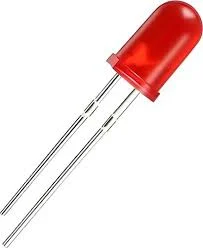
The Hui Yuan 5003R1D-EHB is a 5 mm (T-1 ¾) red diffused LED with an AlGaInP semiconductor. It gives a luminous intensity of 100–150 mcd at 20 mA at a wavelength of 620–635 nm. Thanks to its 50–60° viewing angle and matte lens it spreads the light widely and evenly. Its forward voltage at 20 mA is 1.9–2.3 V and its maximum continuous forward current is 30 mA. It works from -40 to +80 °C and is suitable for through-hole (THT) mounting.
You can order this product from Fark Tedarik with a company invoice:
You can browse other LED and display products in our LEDs and Displays category.
Additional Advantages and Usage Tips
The series resistor value is calculated with this formula: R = (Supply voltage − LED forward voltage) / LED current. For example, with a 5 V supply, 2 V forward voltage and 15 mA current, R = (5 − 2) / 0.015 = 200 Ω, and 220 Ω can be chosen as the standard value. In indicator applications, driving the LED at 10–20 mA rather than at the maximum current gives enough brightness and extends its life.
If you want to control many LEDs with few microcontroller pins you can use a shift register, and to show letters and digits you can take a look at dot matrix LED displays. For bulk purchases contact Fark Tedarik: https://farktedarik.com/iletisim/.
Frequently Asked Questions
What is the difference between a diffused LED and a clear LED?
A diffused (matte) LED spreads the light through the body and looks even from a wide angle, it is ideal for indicator applications. A clear LED concentrates the light in a narrow angle, looks brighter from the front and is preferred for lighting or for signals that must be seen from a distance.
What resistor does a red LED need at 5 V?
For about 2 V forward voltage and 15 mA current the result is 200 Ω, in practice 220 Ω is used. If lower brightness is enough, 330 Ω or 470 Ω can also be chosen.
How can you tell the plus and minus legs of an LED?
The long leg is the anode (+), the short leg is the cathode (−). The flat edge of the LED body also marks the cathode side.
Can an LED be connected without a resistor?
It should not be. Since the LED current rises very quickly with voltage, connecting it without a resistor quickly destroys the LED. A series resistor or a constant current driver should always be used.